
Reviews
London, Manchester and Edinburgh agency day rates compared
Content marketing agency day rates in London, Manchester and Edinburgh compared using rate cards, ONS earnings data and published tender figures.
What to take away
- A content marketing agency day rate in the UK is a quoted price for a named seniority, not a single market number.
- London day rates run highest, Manchester sits roughly a fifth to a third below London, and Edinburgh sits between the two with public sector work pulling in both directions.
- ONS earnings and business data explain most of the gapwages, business counts and sector mix, not agency greed.
- Published tender figures and agency rate cards are the only defensible benchmarks for procurement, because they show what buyers actually paid.
- A blended rate model across the three cities is how most UK brands now buy content without paying London prices for every task.
How to read a UK agency day rate in 2026
A day rate is a price for one person's working day, usually seven or eight hours. It is not a project price, and it is not a retainer. Agencies quote it because procurement teams ask for a comparable unit.
What builds a UK day rate
- Salary
- Employer costsNI, pension, holiday
- Overheaddesks, software, insurance
- Margin keeps agency trading
- VAT added separately
- IR35 raises freelancer fees
The number you receive is built from four things: salary, employer costs, overhead and margin. Employer costs in the UK include National Insurance, pension contributions and holiday cover. Overhead covers desks, software, insurance and management time. Margin is what keeps the agency trading.
Seniority matters more than city. A strategy director in Manchester can outprice a junior writer in London. If your tender compares a London account executive with a Manchester head of content, the comparison is worthless.
VAT is separate. Most UK agencies quote day rates excluding VAT, and HMRC rules mean VAT applies to most content services. Budget for it before you compare suppliers.
IR35 and contractor rules also shape the quote. Where an agency supplies a freelancer inside IR35, the fee usually rises to absorb the deemed employment taxes. That is a pricing issue, not a compliance footnote.
Finally, decide what the day includes. Research, travel, stakeholder workshops and revisions are the usual extras. A cheap day rate with billable extras is often the most expensive option on the table.
For a fuller breakdown of how these figures are built, see our guide to UK rates across agency models.
The four components behind every quote
- Salary and employer costs, including National Insurance and pension.
- Overhead, covering premises, software, insurance and management.
- Margin, typically the smallest visible element in a competitive tender.
- Risk, covering scope creep, payment terms and sector compliance.
London day rates by sector and seniority
London is the reference market for UK content pricing. The largest concentration of agencies, in-house brand teams, media owners and regulators sits there, including the ASA and the ICO. That density sets the ceiling other cities are measured against.
Junior content roles in London, meaning one to three years of experience, commonly quote from around £350 to £500 a day. Mid-level writers, editors and social managers sit roughly between £500 and £700.
Senior practitioners, including content strategists and lead editors, usually quote from about £700 to £950. Directors and heads of content move above that, and specialist financial or regulated-sector strategists go higher again.
Sector changes the number. Financial services work carries FCA financial promotion rules, so agencies price in compliance review. Health and pharmaceutical content carries similar scrutiny. Retail and ecommerce content is more competitive because more agencies can do it.
Public sector and charity work in London often prices below commercial rates, but the procurement process is longer and the scope tighter. Do not read a low public sector rate as a discount available to you.
Media and publishing clients in London often negotiate lower day rates in exchange for volume, regular briefs and faster payment. If you can offer those three things, ask for the volume rate explicitly.
London rate ranges by seniority
| Seniority | Typical London day rate |
|---|---|
| Junior (1 to 3 years) | £350 to £500 |
| Mid-level writer, editor or social manager | £500 to £700 |
| Senior practitioner, including content strategist or lead editor | £700 to £950 |
| Director or head of content | Above £950 |
London day rates by seniority
- Junior£350-£500
- Mid-level£500-£700
- Senior£700-£950
- Directorabove £950
Manchester day rates and the northern agency market
The Manchester agency market has grown around MediaCityUK and the Northern Quarter, with strong clusters in retail, ecommerce and fintech. Demand increasingly comes from brands outside London that want northern cost bases with national reach.
Junior content roles in Manchester commonly quote from around £250 to £375 a day. Mid-level writers and editors sit roughly between £375 and £550.
Senior strategists and lead editors usually quote from about £550 to £750. Directors and heads of content typically sit between £750 and £1,000, though the top of that band is rarer than in London.
That puts Manchester roughly a fifth to a third below London for comparable seniority. The gap narrows for specialist skills, because a Manchester agency with genuine financial services experience prices close to London.
Overheads explain much of the difference. Office space, salaries and recruitment costs are lower in the North West, and agencies pass some of that through. Competition also plays a part: more agencies bid for the same briefs.
Travel is the hidden cost. If your team is in London and the agency is in Manchester, workshop days and review meetings add expenses. Some agencies build travel into the day rate, others bill it separately.
Buyers comparing quotes should read our explainer on what drives content agencies costs and pricing for small businesses before assuming a cheaper day rate is better value.
Manchester rate ranges by seniority
| Seniority | Typical Manchester day rate |
|---|---|
| Junior (1 to 3 years) | £250 to £375 |
| Mid-level writer or editor | £375 to £550 |
| Senior strategist or lead editor | £550 to £750 |
| Director or head of content | £750 to £1,000, though the top is rarer |
Manchester day rates by seniority
- Junior£250-£375
- Mid-level£375-£550
- Senior£550-£750
- Director£750-£1,000
Edinburgh day rates and Scottish market conditions
Edinburgh is Scotland's financial, public sector and technology hub, and its content market reflects that mix. Agencies there work with Scottish public bodies, universities and financial institutions, and often run cross-border UK campaigns.
Edinburgh day rates by seniority
- Junior£275-£400
- Mid-level£400-£575
- Senior£575-£775
- Director£775-£1,050
Edinburgh sits between London and Manchester for most roles, but the pattern is uneven. Public sector frameworks can cap rates below commercial levels, while financial services work pushes them up.
Scottish public procurement follows its own routes and thresholds, so tender documents differ from England. If you are buying through a framework, the published rates may already be fixed, and negotiation room is limited to scope.
Cross-border campaigns add a practical cost. Agencies may need to work to both Scottish and England and Wales legal positions on some content, particularly around data protection and advertising claims.
Scottish Government and public body content often requires accessibility standards to be met and evidenced. That work is real and it is priced.
Edinburgh has no single published rate card. The mid-level band is £400 to £575 a day. For other seniority levels, the working range sits between the Manchester and London bands, so use those as the outer bounds.
Edinburgh rate ranges by seniority
| Seniority | Typical Edinburgh day rate |
|---|---|
| Junior (1 to 3 years) | Between £250 and £500 |
| Mid-level writer, editor or social manager | £400 to £575 |
| Senior practitioner or lead editor | Between £550 and £950 |
| Director or head of content | Between £750 and £1,000, subject to public sector caps |
What ONS earnings and business data say about rate pressure
The Office for National Statistics is the most useful public source for benchmarking agency rates, because it publishes labour market data covering professional, creative and digital roles. You can review the employment and employee types data to see how earnings move across occupations and regions.
ONS data to check before pitching
- Employment and employee typesearnings by occupation and region
- Business services statisticsadvertising and market research turnover
- UK business activity, size and locationsupplier counts by region
- ONS business datamarket sizing and demand claims
ONS business services statistics cover advertising and market research directly, which is where most content agencies sit for classification purposes. The business services statistics show turnover and output trends for that part of the economy.
Business counts matter for negotiation. The UK business activity, size and location dataset shows how many businesses operate in each region and how they are distributed by size. More suppliers in a region generally means more price competition.
The wider ONS business data underpins most market sizing and demand claims you will see in agency pitches, so it is worth checking before you accept a supplier's version of the market.
Two pressures push rates up across all three cities. Wages in professional and creative roles have risen, and employers now carry higher pension and National Insurance costs. Both feed directly into day rates.
One pressure pushes back. Remote working has widened the pool of suppliers a London buyer can use, which weakens the London premium at the junior and mid levels. Senior and specialist rates have held up better.
Published tender figures and rate cards as benchmarks
Published tender figures are the strongest evidence you can put in front of a budget holder, because they show what a buyer actually agreed to pay. UK public sector contracts above the relevant thresholds are published, and many include day rate schedules.
For example, the Crown Commercial Service's Digital Outcomes and Specialists 5 framework publishes supplier day rates by named role, including content designers.
Look for the rate card annex in a tender award notice. It usually lists roles and rates, which gives you a defensible range without disclosing anyone's confidential pricing.
Agency rate cards work differently. They are the supplier's own published or shared price list, and they are a starting position rather than a final price. Treat them as the top of the range.
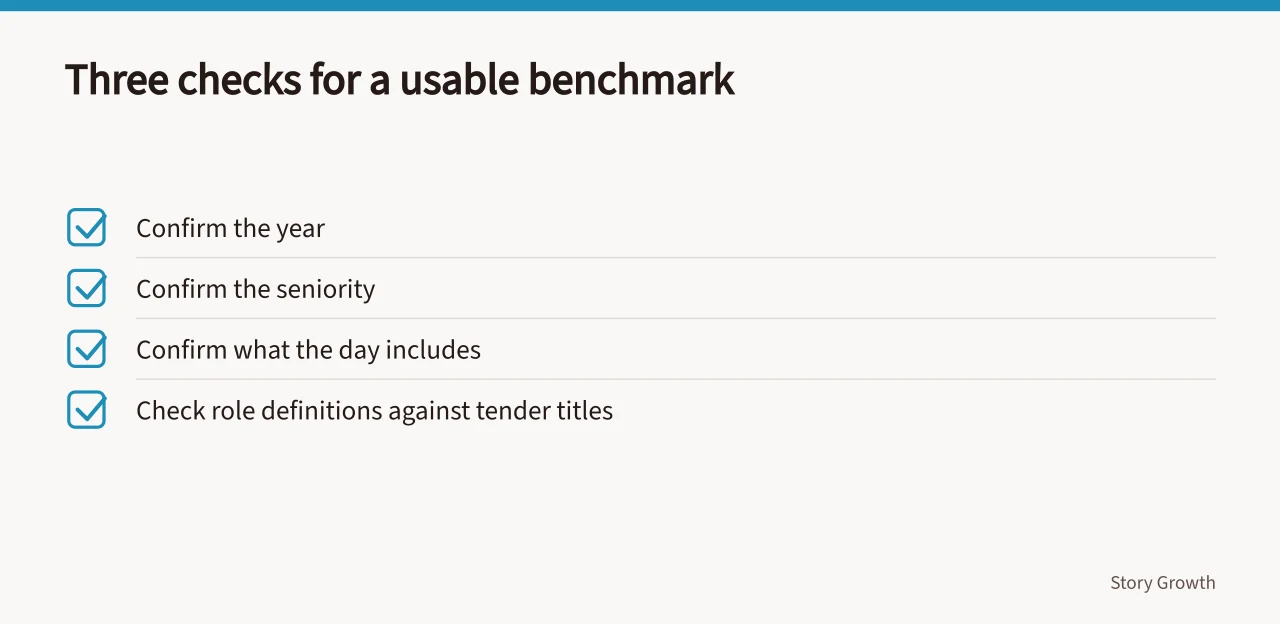
When you compare a rate card with a tender figure, check the role definitions. A tender may price a content designer at a rate that a rate card calls a senior editor. Titles are not standardised across the UK.
For a wider view of how quotes are structured and compared, our article on how content agencies pricing models work is a useful companion to any tender pack.
Worked example: a blended three-city brief
A UK retailer needs 60 days of content work over a year: 20 days of senior strategy, 30 days of mid-level writing and 10 days of junior production.
Quoted entirely in London, at the midpoint of each band, the brief costs roughly £15,000 for strategy, £18,000 for writing and £4,250 for production. That is about £37,250 before VAT and expenses.
Quoted entirely in Manchester, at the midpoint of each band, the same brief costs roughly £13,000, £13,875 and £3,125. That is about £30,000, a saving of roughly £7,250.
A blended model keeps the strategy in London and moves writing and production to Manchester. It lands at roughly £31,625, close to the Manchester total but with London senior input on the strategy.
Building a blended rate model across three cities
A blended rate model means splitting a brief by task and placing each part with the city that prices it best. It works when the work can be separated cleanly and the senior input is genuinely needed.
Building a blended rate model
- List roles, not deliverables
- Decide which roles need proximity
- Price each role in all three cities
- Pick lowest credible rate
- Add coordination cost
- Set annual review point
Start by listing the roles the brief requires, not the deliverables. Strategy, editing, writing, design, production and project management are the usual categories.
Then decide which roles need proximity to your team. Strategy and stakeholder workshops usually do. Volume writing and production usually do not.
Price each role in all three cities using the tables above, then choose the lowest credible rate for each. Credible means the agency can show comparable work, not just a cheap number.
Build in a coordination cost. Managing two or three suppliers takes internal time, and a blended model that saves £5,000 while consuming ten management days is not a saving.
Set a review point. Rates move with wages and demand, so revisit the model annually rather than treating it as fixed.
If you are sizing the supplier pool before you shortlist, our piece on why content agencies market size in England needs better data explains the limits of current figures.
Checklist before you accept a blended model
- Rate card received by named role, not department.
- Seniority definitions agreed in writing.
- Travel and expenses treatment confirmed.
- VAT position stated on every quote.
- Coordination time costed internally.
- Review date set for the next rate refresh.